

ISO 21204 – Transition Specifications in Focus
- ✓
ISO 2768 Is Changing: The revised standard no longer includes the previous general tolerances for radii and chamfers.
- ✓
Unambiguous Transition Specifications (ISO 21204): Function-oriented specification of transitions between adjacent geometric features.
- ✓
Specification and Verification: Why conventional radius and chamfer indications can be ambiguous—and why an unambiguous specification does not necessarily mean more complicated measurement.
1. ISO 2768 Is Changing – What Does This Mean for Radii and Chamfers?
For decades, ISO 2768-1 has been one of the most familiar standards for general tolerances on technical drawings. Its forthcoming replacement by the revised ISO 2768 will significantly change its scope.
The revised ISO 2768 is limited to general tolerancing of linear sizes in accordance with ISO 14405-1 and angular sizes in accordance with ISO 14405-3.
One key change: the previous general tolerances for radii and chamfers will no longer apply under the revised standard.
This raises important questions when creating new technical drawings, particularly where radii or chamfers are dimensioned but have no individually specified tolerances.
How can such geometric features be specified unambiguously in future?
2. ISO 21204 – An Underappreciated Standard for Transition Specifications
This is where it is worth taking a closer look at ISO 21204:2020 – Geometrical Product Specifications (GPS) – Transition specification.
This standard enables certain transitions between adjacent geometric features to be specified unambiguously and in accordance with their functional requirements.
It is not simply about describing the geometry of a radius or chamfer, but about clearly defining the permissible deviations of a transition.
ISO 21204 provides different ways of specifying such transitions. In practice, these can often be easier to apply than the formal definitions initially suggest.
3. “Nobody Can Measure That!” – Really?
Anyone who has examined ISO 21204 in detail is likely familiar with some of its complex definitions and mathematical concepts.
This often leads to the reaction:
“Nobody can measure that!”
What is often overlooked is that conventional radius and chamfer indications can themselves be ambiguous in terms of interpretation and verification.
An apparently simple drawing indication does not automatically result in an unambiguous specification.
This is precisely where ISO 21204 provides a valuable foundation: it enables an unambiguous description of a transition and, in turn, meaningful verification.
However, this does not mean that measurement in practice must necessarily be complicated.
What matters is that the specification reflects the functional requirements of the part, allowing a suitable measurement and evaluation strategy to be derived.
4. Practical Example: Conventional Radius Indication vs. ISO 21204 Transition Specification
The following example illustrates the difference between a conventional radius indication and a transition specification according to ISO 21204.
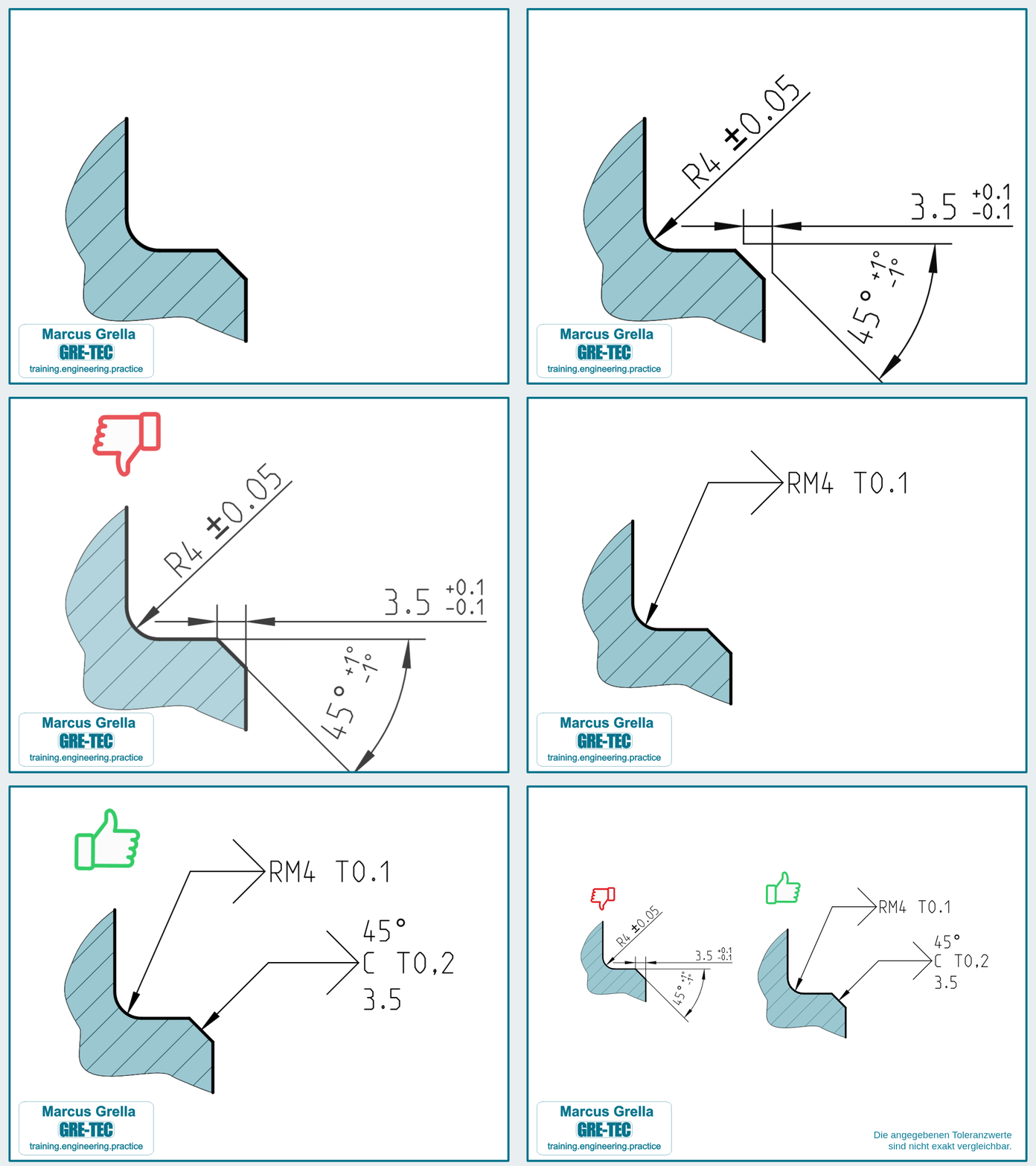
Animation: Comparing a conventional radius indication with a transition specification according to ISO 21204.
The comparison shows that a seemingly straightforward radius indication does not necessarily define the permissible part geometry unambiguously.
The specification methods provided by ISO 21204 allow the requirements for a transition to be defined more precisely.
Especially when design, manufacturing and metrology work together, this can help reduce room for interpretation and align verification more closely with the part’s intended function.
5. ISO GPS in Practice – Training, Workshops and Consulting
Would you like to deepen your understanding of Geometrical Product Specifications or improve the application of ISO GPS within your company?
Through GRE-TEC we offer practical training courses, workshops and consulting services covering Geometrical Product Specifications.
Our focus is on standards-compliant, function-oriented and cost-conscious specification, together with the resulting verification of parts.
In addition, GPS-PRACTICE provides practical examples and further guidance on creating unambiguous technical specifications.
Further information:
If you have technical questions or are interested in working with us, we would be pleased to hear from you.
Recommended ISO GPS Examples & B2B Offers
Free Example (€0)
Explore our cover-plate example free of charge, including a 3D CAD view.
33-1-D Bearing Plate
PDF guide and HD video on ISO 14405-1 tolerancing in mechanical engineering.
Expert Hub (Corporate Partner)
Full access to all practical examples, monthly Microsoft Teams sessions and AI Copilot access via MCP.
Leave a Reply