ISO GPS Practice
Base body
Practical example of the base body of a clamping device. Covers the function-oriented definition and tolerancing of the datum system, the specification of dowel pin holes and threaded holes, as well as the ISO GPS-compliant specification of the eccentric shaft axis.
Also available from the "Clamping device" assembly: the practical example "Clamping piece".
When purchasing this product, you will receive a video (step-by-step guide) and a PDF file.
Scope of Delivery (Digital Package)
- PDF Handbook with ISO 8015 & ISO 14405-1 dimensioning
- 16:9 HD Explanation Video by Marcus Grella
- Interactive 3D-CAD views of references & tolerance zones
- Optional: Physical 3D-printed haptic models for teams
Note: CAD raw files (STP/STEP) are NOT included for IP protection.
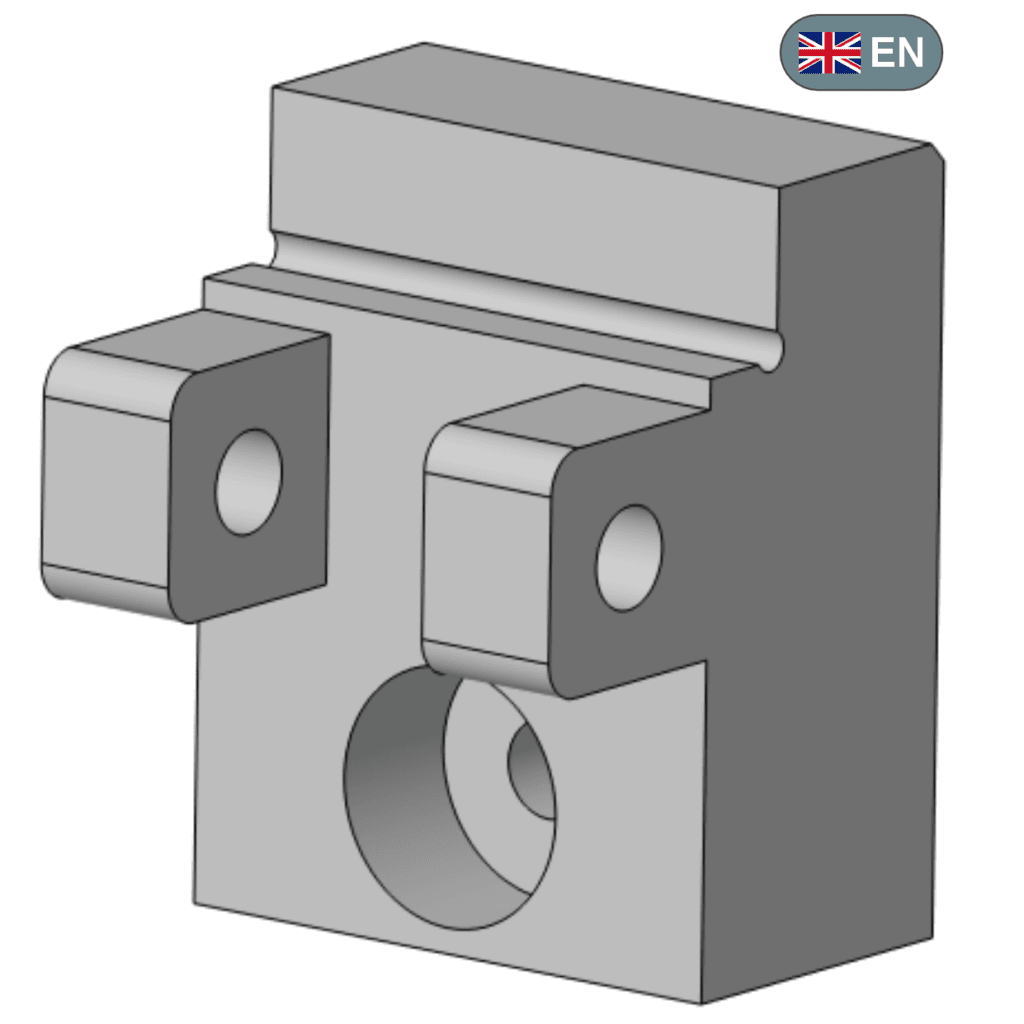


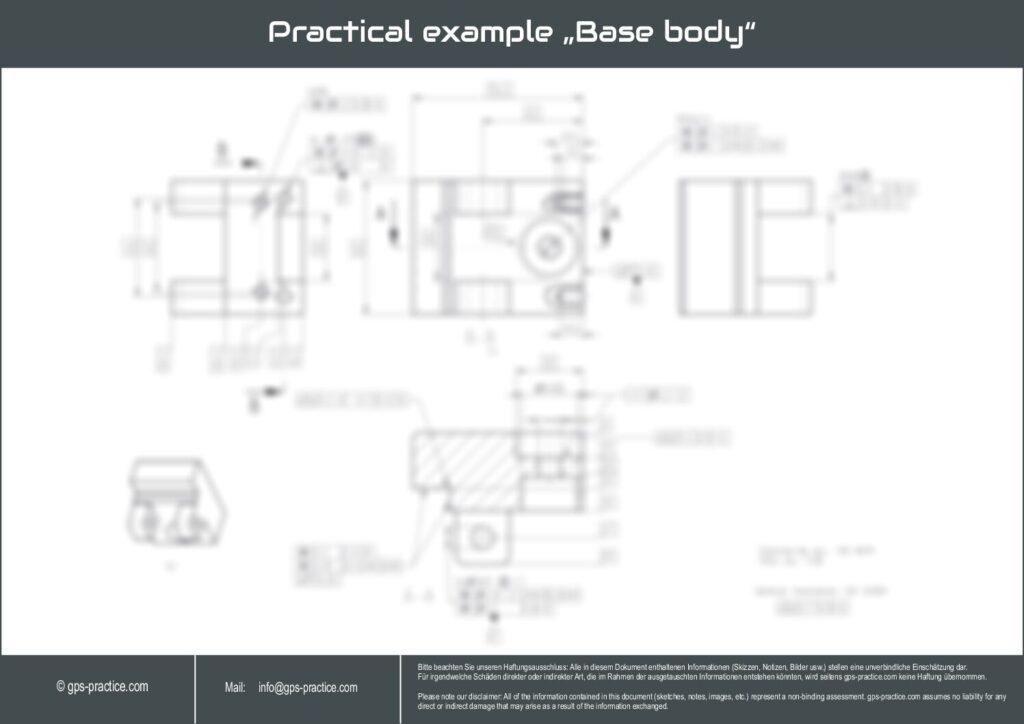
The base body of a clamping device needs to be specified.
.A functional datum system must be defined (and toleranced).
Tolerances apply to pin connections and threaded holes.
In addition to the clamping area for the workpiece, the axis of the eccentric lever must also be described in accordance to ISO GPS.
Length of explanation video (Step by Step guide) : Approx. 34 min.
Variants: No
Difficulty Level: Suitability 1-2
Description of the level of difficulty (suitability for the user):
1 – The user has basic knowledge but has not yet used ISO GPS frequently in practice and takes first steps.
2 – The user has basic knowledge but is not proof about using ISO GPS and would like to gain more general confidence.
More „special“ or complex modifiers (these are usually listed in the example description) are applied selectively.
3 – The user has sufficient knowledge, can already use frequently used ISO GPS tools without difficulty,
and would like to deepen knowledge selectively based on typical functional descriptions,
which is usually also product-specific (e.g., snapping features (latching hooks) on a plastic injection-molded part, special demand hole patterns, i.e. multi-level patterns etc.)
used in the example (i.e., listed in the description) (e.g., direction only or certain combinations of dimensional tolerancing, as well as SIM or similar modifications).
4 – The user has extensive knowledge, has been working with ISO GPS for a long time,
and would like to learn about very specific applications or modification operations, which usually describe more complex functional requirements and products.
This requires, for example, situation features, reference elements, filter information, association modifiers etc.


B2B All-Access: Expert Hub
Full access to all case studies (DE+EN), monthly MS Teams live call & AI MCP Connector for your entire team.